
Buying a home in Alabama has never been more important to plan carefully. Mortgage rates have shifted significantly over the past few years, and understanding where they stand today can save you thousands of dollars over the life of your loan. Whether you are a first-time buyer or moving up to a larger property, knowing the numbers before you shop gives you a real advantage.
This guide covers current mortgage rates in Alabama, how different loan types compare, what the local housing market looks like, and which assistance programs can help you get into a home sooner.
Current Mortgage Rates in Alabama: Where Things Stand in 2026
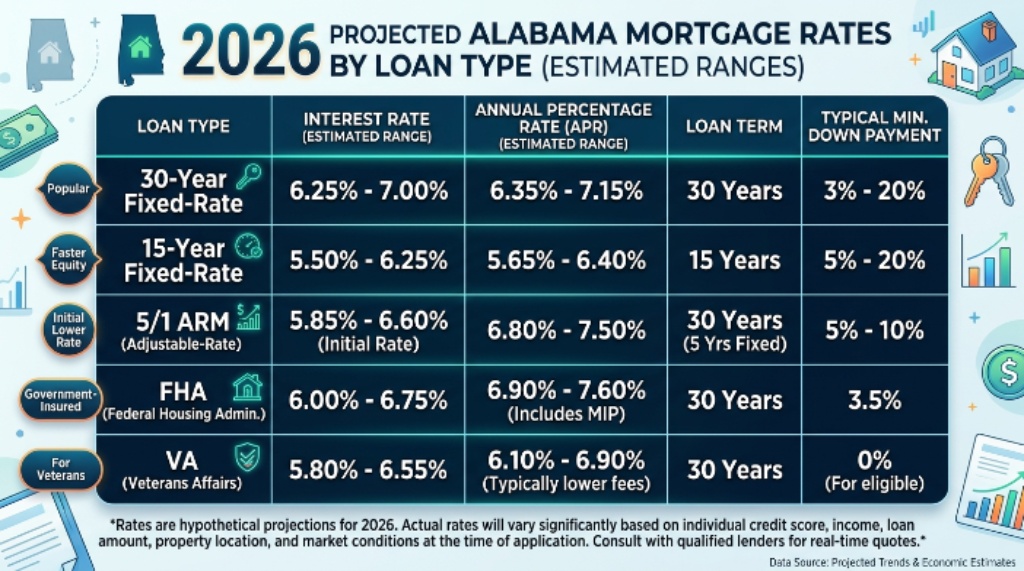
As of mid-2026, mortgage rates in Alabama sit in the mid-to-upper 6 percent range for most standard loan products. The 30-year fixed mortgage rate averages around 6.75 percent, while the 15-year fixed rate comes in closer to 6.125 percent. These figures align closely with national averages, with Alabama typically running just one or two basis points below the national benchmark.
Rates shifted upward over the first half of 2026, rising roughly half a percentage point over 30 days due to inflationary pressures and bond market movements. However, many economists expect modest decreases later in the year, though rates are unlikely to drop 6 percent below in the near term.
| Loan Type | Average Rate | Average APR |
| 30-Year Fixed | 6.75% | 6.92% |
| 15-Year Fixed | 6.125% | 6.42% |
| 30-Year FHA Fixed | 6.25% | 6.90% |
| 30-Year VA Fixed | 6.125% | 6.42% |
| 30-Year Jumbo Fixed | 6.87% | 7.08% |
| 30-Year Fixed Refinance | 6.81% | 6.95% |
| 15-Year Fixed Refinance | 5.90% | 6.10% |
These are average figures sourced from multiple lenders. Your individual rate will vary based on your credit score, loan size, down payment, and the lender you choose.
How Alabama Rates Compare to the National Average
Alabama consistently offers rates that are close to or slightly below the national average. That is a meaningful advantage for buyers in a state where home prices are already well below the US median.
The national 30-year fixed rate APR sits at approximately 6.48 percent as of mid-2026. Alabama’s comparable figure runs slightly higher at around 6.75 percent in rate terms but remains competitive when combined with the state’s lower average home prices.
Additionally, because Alabama home values are roughly 30 percent below the national median, buyers here borrow less overall. This means even a slightly higher rate results in a lower monthly payment compared to many other states.
Understanding the Alabama Housing Market in 2026
Knowing what homes cost in Alabama helps you estimate how much you need to borrow. The statewide average home value sits at approximately 241,500 dollars as of mid-2026, reflecting a 1.5 percent increase over the past year. The median sale price across the state hovers around 235,000 dollars.
Home prices vary considerably by city. Huntsville is the most expensive major market, driven by its defense, aerospace, and technology sectors. Birmingham offers more affordable entry points and a balanced inventory environment. Montgomery remains the most accessible option for buyers watching their budget.
| City | Median Home Price | Year-over-Year Change | Average Days on Market |
| Huntsville | $350,000 | +3.5% | 54 days |
| Birmingham | $210,000 | +15.6% | 55 days |
| Montgomery | $197,250 | +5.2% | 60 days |
| Tuscaloosa | $245,000 | Stable | 50 days |
| Mobile | Below state median | Stable | 60+ days |
Alabama’s overall market is balanced, with roughly 4.2 months of housing supply statewide. Markets with fewer than 4 months of supply tend to favor sellers, while more than 6 months favor buyers. Therefore, most Alabama buyers currently operate in relatively neutral territory.
Types of Mortgage Loans Available in Alabama
Understanding your loan options is one of the most important steps in the homebuying process. Each loan type carries different rate levels, qualification requirements, and down payment needs.
30-Year Fixed-Rate Mortgage
This is the most popular choice for Alabama buyers. The rate stays the same for the entire loan term. Monthly payments are predictable and manageable. However, you pay more interest over time compared to shorter-term loans. This loan suits buyers who plan to stay in their home for many years.
15-Year Fixed-Rate Mortgage
This option cuts your interest costs significantly. The rate is lower than a 30-year loan, and you pay off the home in half the time. Monthly payments are higher, however. This loan works well for buyers with high income who want to build equity faster.
FHA Loan
Backed by the Federal Housing Administration, this loan accepts credit scores as low as 580 with a 3.5 percent down payment. For buyers with scores between 500 and 579, a 10 percent down payment is required. FHA loans carry monthly mortgage insurance premiums. They are a popular choice for first-time buyers with limited savings.
VA Loan
Available to eligible veterans, active-duty service members, and surviving spouses. VA loans require no down payment and no private mortgage insurance. Rates are often lower than conventional options. Alabama has a significant military and veteran population, making this loan type widely relevant across the state.
USDA Loan
Designed for rural and suburban buyers, USDA loans require no down payment. Much of rural Alabama qualifies for this program. Income limits apply, but they are generous enough to include many moderate-income households. This is one of the most overlooked loan programs available to Alabama buyers.
Jumbo Loan
For home purchases above the conventional conforming loan limit of 806,500 dollars in 2026, buyers need a jumbo loan. These carry higher rates and stricter qualification requirements. Huntsville is the primary Alabama market where jumbo loans come into play given its higher price points.
Alabama Down Payment Assistance Programs
One of the biggest barriers for homebuyers is the upfront cost. Alabama offers several strong assistance programs that help buyers cover down payments and closing costs.
AHFA First Step Program
The Alabama Housing Finance Authority runs this program for first-time and repeat buyers. It offers below-market, 30-year fixed mortgage rates on FHA, VA, USDA, and HFA Advantage conventional loans. Buyers can receive up to 10,000 dollars or 4 percent of the home price in down payment assistance, whichever is lower. Nearly 50,000 Alabama households have benefited from this program to date.
AHFA Step Up Program
The Step Up program targets moderate-income buyers who can afford a monthly payment but need help with upfront costs. It provides down payment assistance of up to 3 percent of the purchase price, structured as a 10-year second mortgage. To qualify, buyers need a credit score of at least 620 and a household income that does not exceed 97,300 dollars annually.
City-Level Assistance Programs
Several Alabama cities run their own programs alongside state offerings.
- Huntsville: Up to 10,000 dollars for new construction and up to 7,500 dollars for existing homes. Offered as a zero-interest second mortgage, forgiven after five consecutive years of residency.
- Mobile: Up to 15,000 dollars in down payment and closing cost assistance for income-eligible first-time buyers.
- Tuscaloosa: Down payment and closing cost assistance for income-eligible buyers who have not owned a home in the past three years.
Mortgage Credit Certificate Program
The Mortgage Credit Certificate, or MCC, provides a federal tax credit based on a portion of the mortgage interest paid each year. This reduces your overall tax burden annually for the life of the loan. Many buyers combine an MCC with other AHFA programs for maximum savings.
Key Factors That Affect Your Mortgage Rate in Alabama
Lenders use several personal financial factors to determine the rate they offer you. Understanding these helps you prepare before applying.
- Credit score: Borrowers with scores above 740 typically receive the most competitive rates. A score below 620 limits your options and raises your rate significantly.
- Down payment size: A larger down payment reduces lender risk. Putting down 20 percent or more eliminates private mortgage insurance and often lowers your rate.
- Loan term: Shorter loan terms carry lower rates. A 15-year loan will always come with a better rate than a 30-year loan.
- Debt-to-income ratio: Most lenders prefer a ratio of 45 percent or below. This means your total monthly debt payments, including your new mortgage, should not exceed 45 percent of your gross monthly income.
- Loan type: Government-backed loans such as VA and USDA often carry lower rates than conventional loans because the government reduces lender risk.
- Property type: Rates for primary residences are lower than those for investment properties or second homes.
Tips for Getting the Best Mortgage Rate in Alabama
A few smart steps before and during the application process can lead to meaningful savings.
- Compare at least three to five lenders before committing. Rates and fees vary more than most buyers expect.
- Get pre-approved before shopping for homes. Pre-approval shows sellers you are a serious buyer and locks in a rate for a set period.
- Improve your credit score before applying. Even a 20-point improvement can move you into a lower rate tier.
- Ask about discount points. Paying points upfront reduces your interest rate over the life of the loan, which can save money if you plan to stay long-term.
- Consider locking your rate once you go under contract. Rates move daily, and a rate lock protects you from increases during the closing process.
- Use AHFA programs if you qualify. The savings on down payment and closing costs free up cash reserves that strengthen your financial position overall.
Conclusion
Current mortgage rates in Alabama sit around 6.75 percent for a 30-year fixed loan and 6.125 percent for a 15-year fixed loan as of mid-2026. While rates remain elevated compared to historical lows, Alabama’s below-average home prices keep monthly payments manageable for many buyers. The state’s housing market is balanced, with reasonable inventory and steady price growth across major cities. First-time buyers and moderate-income households benefit from strong state-level assistance programs through the Alabama Housing Finance Authority, as well as city-level grants in Huntsville, Mobile, and Tuscaloosa. Comparing lenders, improving your credit profile, and exploring assistance programs are the three most impactful steps any Alabama homebuyer can take before signing on the dotted line.
Frequently Asked Questions
What is the current 30-year fixed mortgage rate in Alabama?
As of mid-2026, the average 30-year fixed mortgage rate in Alabama is approximately 6.75 percent, with an APR of around 6.92 percent. Rates change daily based on economic conditions, so checking with multiple lenders before applying is always recommended to ensure you get the most current figure.
Can first-time homebuyers in Alabama get down payment assistance?
Yes. The Alabama Housing Finance Authority offers two main programs — First Step and Step Up — that provide down payment assistance of up to 10,000 dollars or 3 to 4 percent of the home price. Several cities, including Huntsville and Mobile, also run their own local assistance programs with grants ranging from 7,500 to 15,000 dollars.
What credit score do I need to get a mortgage in Alabama?
The minimum credit score depends on the loan type. FHA loans accept scores as low as 580 with a 3.5 percent down payment. Conventional loans typically require a score of at least 620 to 640. VA and USDA loans have flexible requirements, but most lenders still prefer a score of 620 or above. Higher scores consistently lead to better interest rates.
Are USDA loans available in Alabama?
Yes. Much of rural Alabama qualifies for USDA Rural Development loans, which require no down payment. These loans come with income limits that vary by county but are generous enough to cover many moderate-income households. Urban areas like Birmingham and Huntsville generally do not qualify, but surrounding suburban and rural counties often do.
How do Alabama mortgage rates compare to national averages?
Alabama mortgage rates run very close to the national average, typically within one to three basis points of the benchmark 30-year fixed rate. Because home prices in Alabama average roughly 30 percent below the national median, buyers in the state borrow less and often end up with lower monthly payments than buyers in more expensive states, even when rates are similar.
