
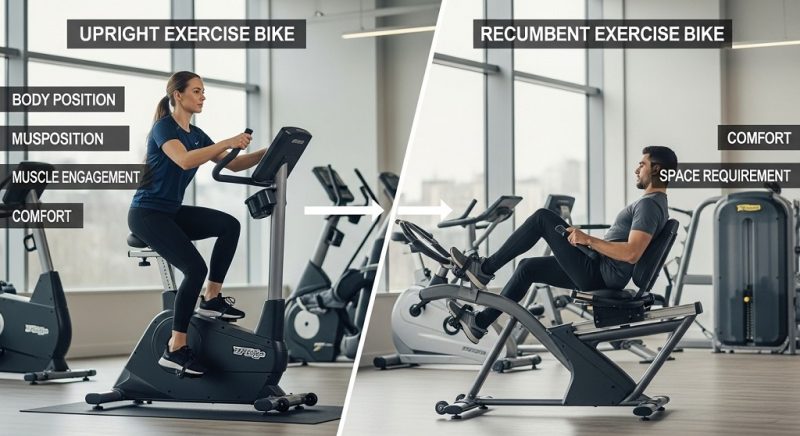
Upright bikes mimic outdoor cycling and focus on performance and calorie burn, while recumbent bikes offer back support and comfort with lower joint stress.
Choosing an exercise bike looks simple. Until you face the real question: upright or recumbent? Many buyers make the mistake of picking based on looks or price. That often leads to discomfort, low usage, and wasted money.
If your goal is weight loss, daily cardio, injury recovery, or long-term fitness, the type of bike matters more than brand or features. Upright and recumbent bikes serve very different users, even though both are stationary exercise bikes.
This guide explains how to compare exercise bikes step by step. You’ll learn how body position, muscle engagement, calorie burn, comfort, and real-world use differ between an upright vs recumbent exercise bike.
We follow a simple PAS framework:
- Problem: People buy the wrong bike and stop using it.
- Agitate: Discomfort, back pain, poor results, and wasted space.
- Solution: Match the bike type to your body, goals, and lifestyle.
Let’s break it down with clear answers first. Then we go deeper, so you can make a confident decision.
How Do You Compare Exercise Bikes Based on Riding Position?

Short answer: Upright bikes keep you vertical like a road bike. Recumbent bikes place you in a reclined, seated position with back support.
The riding position affects comfort, muscle use, and endurance.
Upright Bike Riding Position
- Torso is vertical or slightly forward
- Hands rest on front handlebars
- Core and upper body stay engaged
This position feels familiar if you’ve ridden a regular bicycle. It demands more balance and posture control.
Recumbent Bike Riding Position
- Seated with a backrest
- Feet pedal forward, not downward
- Minimal pressure on spine and wrists
This setup reduces strain on the lower back and hips. It’s often chosen by older adults or people with mobility limits.
Comparison insight: If posture fatigue stops you from finishing workouts, recumbent bikes often lead to longer sessions.
Which Burns More Calories: Upright or Recumbent Exercise Bike?
Short answer: Upright bikes usually burn more calories per minute at the same resistance.
Calorie burn depends on muscle engagement and effort level.
Calorie Burn on Upright Bikes
Upright bikes activate:
- Quadriceps
- Hamstrings
- Glutes
- Core muscles
Because you support your body weight and stabilize your posture, energy output increases.
Case data: According to MET (Metabolic Equivalent) values, moderate upright cycling averages 7–8 METs.
Calorie Burn on Recumbent Bikes
Recumbent bikes mainly target:
- Quadriceps
- Hamstrings
- Glutes (less activation)
Back support lowers total muscle demand.
Case data: Moderate recumbent cycling averages 5–6 METs.
Reality check: A bike you use for 45 minutes beats one you quit after 10. Comfort can outweigh raw calorie numbers.
How Do Upright and Recumbent Bikes Compare for Weight Loss?
Short answer: Upright bikes support faster weight loss. Recumbent bikes support consistency.
Weight loss comes from calorie deficit and adherence.
Upright Bike for Weight Loss
- Higher intensity workouts
- Better for HIIT and intervals
- Shorter sessions, higher burn
This works well for busy users with good joint health.
Recumbent Bike for Weight Loss
- Longer low-impact sessions
- Lower fatigue
- Reduced injury risk
Existing gym data: Users on recumbent bikes average 20–30% longer workout duration per session.
Bottom line: Choose the bike you will ride most days of the week.
Which Is Better for Knee, Hip, and Back Pain?
Short answer: Recumbent exercise bikes are safer for joint and back issues.
Joint Stress Comparison
| Body Area | Upright Bike | Recumbent Bike |
|---|---|---|
| Knees | Moderate load | Lower load |
| Hips | Higher flexion | Reduced flexion |
| Lower Back | Unsupported | Fully supported |
Physical therapists often recommend recumbent bikes during rehabilitation.
Important note: Upright bikes are still safe for healthy users when seat height and posture are correct.
How Do You Compare Exercise Bikes for Home Use and Space?
Short answer: Upright bikes take less space. Recumbent bikes need more room.
Space and Storage
- Upright bikes: Smaller footprint, easier to move
- Recumbent bikes: Longer frame, heavier build
If you live in an apartment or small room, upright bikes fit better.
If space is not a concern, comfort becomes the deciding factor.
Which Type Is Better for Beginners?
Short answer: Recumbent bikes are more beginner-friendly.
New users often struggle with:
- Saddle discomfort
- Balance fatigue
- Lower back strain
Recumbent bikes remove these barriers.
Beginner adherence data: Fitness centers report higher 30-day retention for recumbent bike users over age 40.
How Do Upright and Recumbent Bikes Compare for Seniors?
Short answer: Recumbent bikes are safer and easier for seniors.
Key senior-friendly benefits:
- Low step-through design
- Stable seating
- Minimal fall risk
Upright bikes may still work for active seniors with cycling experience.
Which Exercise Bike Is Better for Cardio Training?
Short answer: Upright bikes provide stronger cardiovascular conditioning.
Upright bikes allow:
- Standing pedaling
- Sprint intervals
- Heart rate spikes
Recumbent bikes deliver steady-state cardio with less intensity variation.
How Do You Compare Exercise Bikes by Comfort?
Short answer: Recumbent bikes win on comfort.
Comfort factors include:
- Seat width
- Back support
- Pressure points
Upright bike seats can cause discomfort during long sessions without proper padding.
Recumbent seats distribute weight evenly.
Which Is Better for Long-Term Use?
Short answer: The bike that matches your physical needs lasts longer in real life.
Usage trends show:
- Upright bikes peak in early motivation phases
- Recumbent bikes show steadier long-term usage
Comfort drives consistency.
Conclusion: How Should You Choose Between Upright and Recumbent Exercise Bikes?
Comparing exercise bikes is not about which is better. It’s about which is better for you.
If you want higher intensity, faster calorie burn, and compact design, an upright bike makes sense.
If you value comfort, joint safety, and long sessions, a recumbent bike is the smarter option.
The biggest mistake is buying based on trends. The best bike is the one you’ll ride three to five times a week.
Call to Action: Before you buy, list your fitness goal, space, and physical limits. Then test both styles if possible. If you found this guide helpful, share it or bookmark it for later.
Frequently Asked Questions About Upright vs Recumbent Exercise Bikes
Which is better for weight loss, upright or recumbent bike?
Upright bikes burn more calories per minute. Recumbent bikes support longer sessions. Both work if used consistently.
Is a recumbent bike easier on knees?
Yes. The reclined position reduces joint stress and knee load.
Can you build muscle on an exercise bike?
You can strengthen leg muscles. Upright bikes engage more stabilizing muscles.
Are upright bikes bad for your back?
No, if posture and seat height are correct. Recumbent bikes offer more support.
Which exercise bike is best for beginners?
Recumbent bikes are easier and more comfortable for beginners.
Do upright bikes take less space?
Yes. Upright bikes have a smaller footprint.
Can seniors use upright exercise bikes?
Yes, but recumbent bikes are safer for most seniors.
Related Topics: How to Choose the Right Modern King Bedroom Set
Related Topics: How to Rent a 3 Bedroom Apartment Without Overpaying
